5 Signs It's Time to Stop Renovating and Start Upsizing
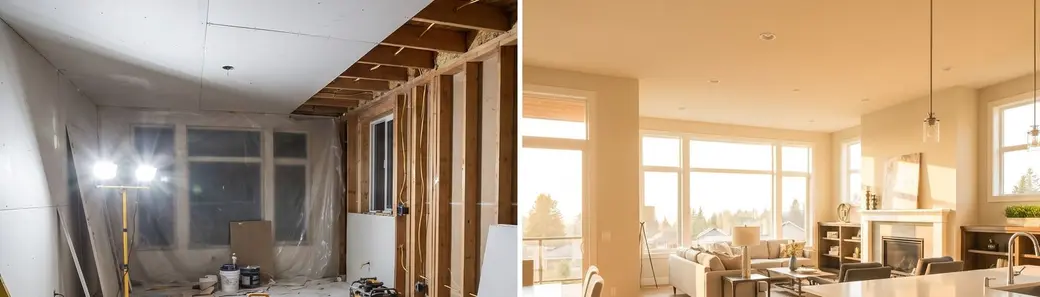
Renovation culture in Ontario is real. Homeowners pour money into their properties every year, kitchens, bathrooms, basements, and addition, convinced that the next project will finally make the home feel right. Sometimes it does. Often, it doesn't. And sometimes, all the renovation money in the world can't solve the underlying problem: the home is simply too small for the life you're living in it.
How do you know which situation you're in? Here are five signs that your renovation budget would be better invested in an upsize, and how to think through the financial case for making the move.
Sign 1: You're Renovating to Solve a Square Footage Problem
This is the most fundamental indicator. If the core issue is that you don't have enough space, not enough bedrooms, not enough living area, and not enough storage, renovation rarely solves it. You can rearrange what exists, but you can't add more floor space without a major structural addition.
Additions are expensive and complicated. In the GTA, a modest two-storey addition can cost $300,000 to $500,000 or more when you factor in permits, engineering, foundation work, and finishes. And when all is said and done, you still have the same lot, the same neighbourhood, and the same infrastructure that may be inadequate for your needs.
If you've started thinking about an addition, stop. Run the comparison: what does an addition actually cost versus what would that same money (or the equity you'd unlock from your current home) get you in the next property up?
Sign 2: Your Family Has Changed, But Your Home Hasn't
Life stages drive real estate decisions more than market conditions do. If you've had children since buying your home, welcomed an aging parent, are regularly hosting family from out of town, or are working from home and need dedicated office space, your home's functional layout may simply no longer fit your daily reality.
Sharing a bathroom with three people, having children sharing bedrooms who no longer want to, or converting your dining room into a home office are all signals worth paying attention to. These aren't inconveniences, they compound over time and quietly reduce your quality of life.
When your home is no longer designed for the life you're actually living, the renovation question becomes: can you redesign the existing structure to solve these problems at a reasonable cost, or would that money be better spent in a home that's already the right size?
Sign 3: You've Hit the Neighbourhood Value Ceiling
Every neighbourhood has a ceiling, the maximum price that the best home on the street can reasonably achieve, regardless of how beautifully it's renovated. If your home is already near the top of comparable sales in your area, additional renovation dollars yield diminishing returns. You're over-improving for your street.
The practical implication: you spend $80,000 renovating a kitchen and bathrooms, but comparable homes in your neighbourhood sell for only $50,000 more than what you were already worth. You've spent $80,000 to recover $50,000 in value. That's a guaranteed loss.
Your agent can show you the comparable sales and the value ceiling for your specific street and area. If you're already close to that ceiling, the renovation case evaporates. Every dollar you spend over-improving your current home is a dollar that would have worked harder in equity if channelled into an upsize.
Sign 4: Your Current Renovations Are Creating New Problems
Some homes resist renovation. Older homes with outdated electrical panels, knob-and-tube wiring, original plumbing, or structural quirks that don't accommodate modern layouts often present a cascading renovation problem: you open one wall and discover three more issues that need to be resolved before you can proceed. Every project leads to another. The budget grows. The timeline extends. The disruption mounts.
If you've found yourself in a renovation spiral, where every project reveals unexpected costs that weren't in the original scope, this is a strong signal to stop and evaluate the bigger picture. At some point, the total cost of getting an older home to modern standards exceeds the cost of simply buying a newer, better-suited property outright.
Sign 5: You've Stopped Loving the Neighbourhood
Renovation can improve a home. It cannot improve a neighbourhood. If your dissatisfaction is rooted in the area, the commute is too long, the school options don't fit where your family is going, or the lifestyle doesn't match who you've become, no amount of granite countertops will fix that. Yet many homeowners pour money into improving the interior while quietly resenting the location.
The GTA has a large and diverse geography. If the neighbourhood is the real problem, the only solution is to move. And if you're going to move, the question becomes, why not also solve the space and layout issues at the same time?
The Renovation vs. Upsize Financial Calculation
Here's a useful framework for running the numbers:
- Get a market evaluation on your current home: Know exactly what it would sell for today
- Get a realistic renovation estimate: Not a budgeted number, a full contractor quote including contingency
- Calculate the post-renovation value: What would comps suggest your home would be worth after the renovation?
- Calculate your ROI: Post-reno value minus current value, divided by renovation cost. If this number is below 70 cents on the dollar, the renovation is likely value-negative.
- Compare to upsize equity: If you sold today and bought a larger home that already meets your needs, what would that cost? What would your monthly payment look like? What would you gain in quality of life?
For many GTA homeowners, this exercise reveals that the upsize is the better financial and lifestyle decision; they just hadn't done the math yet.
The Right Question to Ask
Stop asking, "How much would it cost to renovate this home to what I want?" Start asking: "Is this home, even with renovations, capable of becoming what my life needs it to be?"
Sometimes the answer is yes, and renovation is the right move. But often, especially after significant appreciation in your current home's value, the equity you've built is the most powerful tool you have, and deploying it into the right next home delivers far more value than another renovation project.
Curious about what your current home would sell for today and what that equity could get you in an upsize? Reach out, we'll run the numbers together and give you a clear picture of both paths.
Categories
Recent Posts