Condos vs. Bungalows: What GTA Downsizers Need to Know Before Deciding
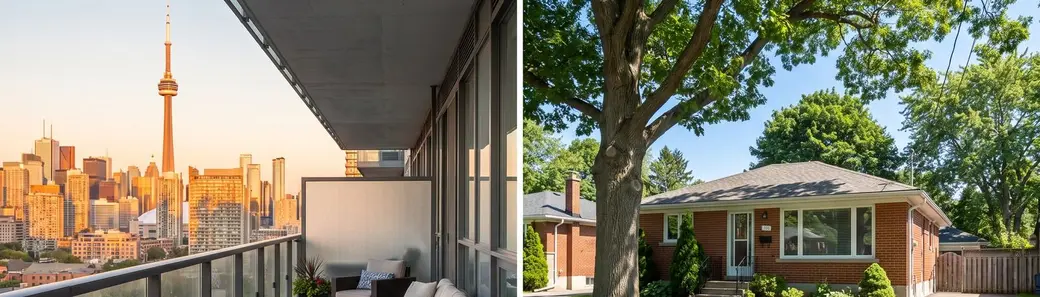
When GTA homeowners decide to downsize, one of the first and most fundamental decisions they face is the property type question: condo or bungalow? Both can be excellent downsizing options. Both come with real trade-offs. And the right answer depends entirely on your lifestyle, your health trajectory, your financial priorities, and how much independence you want in your living environment.
This guide breaks down the real differences, not just the surface-level comparison, so you can make a decision you'll be comfortable with for the next chapter of your life.
The Case for a Condo
Maintenance-Free Living
For many downsizers, the most compelling argument for a condo is the elimination of exterior maintenance. No lawn to cut, no snow to shovel, no roof to replace, no eaves to clean. The building's maintenance is handled by professional management, paid for through monthly condo fees. For those who no longer want to spend weekends on home maintenance, or who are physically unable to, this is genuinely transformative.
Building Amenities
Well-built condos in the GTA often include concierge service, fitness facilities, party rooms, and guest suites for visiting family, and in newer buildings, outdoor terraces and social spaces. For downsizers looking to maintain an active social life without leaving the building, these amenities can genuinely deliver on that promise.
Location Advantages
The best-maintained, most amenity-rich condos in the GTA tend to be in urban and inner suburban locations, walkable to transit, shopping, restaurants, and medical facilities. For downsizers who want to reduce or eliminate their car dependence, a well-located condo can enable a lifestyle that a suburban bungalow cannot.
One-Level Living
Most condo units are on a single floor, which is a significant advantage as mobility changes. No stairs to navigate means the home ages better with you, a practical consideration that becomes more important over time.
The Watch-Outs with Condos
Monthly Condo Fees
Condo fees are the most significant financial variable in the condo ownership equation. Fees in the GTA range dramatically:
- Newer, smaller buildings: $400–$600/month
- Mid-size buildings with moderate amenities: $600–$900/month
- Luxury or high-amenity buildings: $1,000–$2,000+/month
These fees cover utilities (in many older buildings), building insurance, maintenance staff, and contributions to the reserve fund. They are not static; fees can and do increase over time, especially in buildings with aging infrastructure or depleted reserve funds.
Reserve Fund Health Is Critical
Before buying any condo, always review the Status Certificate, particularly the reserve fund study and balance. A healthy reserve fund means the building is financially prepared for major capital expenses (roof, elevators, windows, plumbing). A depleted or poorly funded reserve means future special assessments and unexpected large bills to all unit owners to cover unbudgeted expenses. These can range from a few thousand to tens of thousands of dollars per unit.
Loss of Autonomy
Condo living involves shared governance through a condo board. Rules govern everything from renovation permissions to pet ownership, short-term rentals, and noise. For homeowners who value total independence in how they use their space, this adjustment can be challenging. Read the condo's rules and bylaws carefully before you buy.
Resale Considerations
The GTA condo market has seen significant oversupply in certain price ranges and building types. Not all condos are equally resaleable. Buildings with strong management, reasonable fees, and good locations tend to hold their value better. Older, fee-heavy buildings in fringe locations can be difficult to sell when the time comes.
The Case for a Bungalow
Independence and Ownership
A bungalow gives you freehold ownership, the land is yours, the exterior is yours, and no board governance determines how you use your space. For homeowners transitioning from a large detached home, this familiarity and independence can be deeply important to their comfort and sense of self.
Single-Level Living
Like a condo, a well-designed bungalow offers main-floor living and no stairs, which supports aging-in-place. Many bungalows also offer main-floor laundry, which is another significant lifestyle advantage as mobility changes.
Outdoor Space
Bungalows come with a yard. For downsizers who love gardening, entertaining outdoors, having a dog, or simply wanting private outdoor space to sit in, this is non-negotiable. No balcony substitutes for a yard if outdoor space matters deeply to your daily life.
No Monthly Fees
You own the property outright; there are no mandatory monthly fees beyond property taxes and utilities. This predictability and control over costs is appealing to buyers on fixed incomes who want to know exactly what their housing costs are each month.
The Watch-Outs with Bungalows
Maintenance Remains Your Responsibility
All exterior maintenance, landscaping, roof, eaves, driveway, windows, and foundation - is your responsibility and expense. If you're healthy and enjoy the upkeep, this may not feel like a burden. If you're planning ahead for a time when you may not be able to manage it, budget for ongoing professional help or reconsider whether a bungalow is the right long-term choice.
Bungalows Are Scarce and Expensive
Well-maintained, single-story freehold homes are in high demand in the GTA, they're a finite and diminishing supply, especially as older bungalows are torn down and replaced with two-story ones. Good bungalows are priced at or above comparable two-story homes per square foot in many GTA communities, reflecting their desirability among downsizers and developers alike.
A Decision Framework for Downsizers
Ask yourself these questions honestly:
- Do I genuinely want to eliminate exterior maintenance, or do I still enjoy the activity of homeownership?
- How important is private outdoor space to my daily life?
- Am I planning for a 5-year or a 20-year home? (Condos typically age better with you if major health changes occur)
- Can I comfortably afford condo fees in addition to any mortgage, on a fixed or retirement income?
- Am I comfortable with shared governance, or will the loss of control over my environment be a source of ongoing frustration?
- Where do I want to live, and which property type is more available in that location?
The answers to these questions, not the price comparison alone, should drive your decision.
The Hybrid Option: Condo Townhouse
Worth mentioning: the condo townhouse is an increasingly popular middle ground for GTA downsizers. You get a multi-level freehold-feel layout, private outdoor space (typically a small yard or patio), and shared maintenance of the exterior and common areas. Monthly fees are usually lower than high-rise condos. It's worth including on your shortlist if neither a full condo nor a bungalow feels quite right.
Whatever direction you're leaning, the most important step is getting accurate, current information, market data, comparable sales, and status certificates before making a decision of this magnitude. Reach out to discuss your specific situation. There's no rush and no pressure, just clarity.
Categories
Recent Posts